Starting a craft distillery is both an exciting creative journey and a serious business decision. While branding, recipes, and storytelling often get the spotlight, many distilleries succeed—or fail—based on one fundamental choice: distillation equipment.
Choosing the right distillation system is not just about producing alcohol. It determines your spirit style, production efficiency, operating costs, scalability, and long-term competitiveness. This guide is written for founders and decision-makers who want to understand distillation equipment from both a technical and commercial perspective.
1. Distillation Equipment: More Than a Still
Many first-time distillery founders assume the still is the only critical component. In reality, distillation is part of a complete production system, and every upstream decision affects spirit quality and consistency.
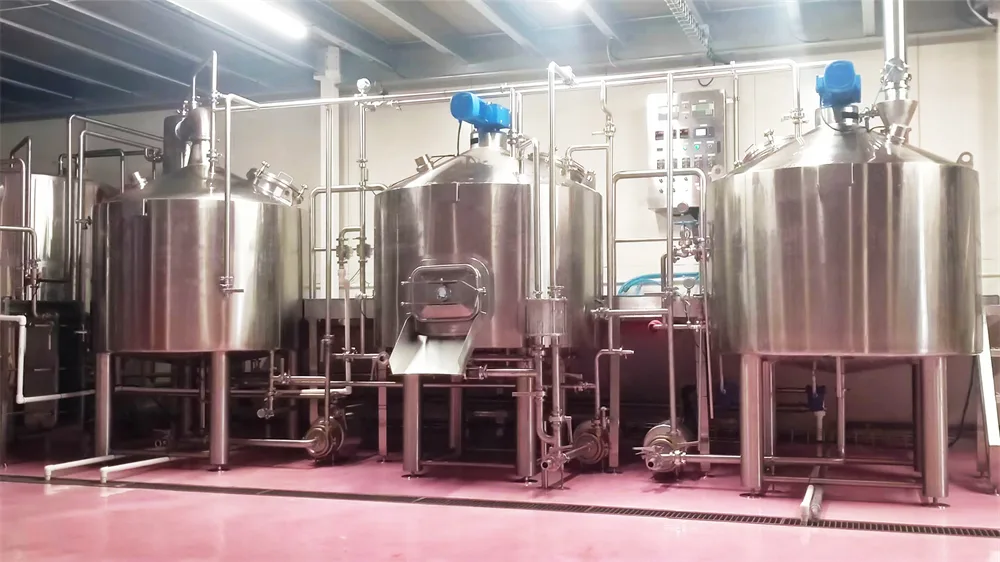
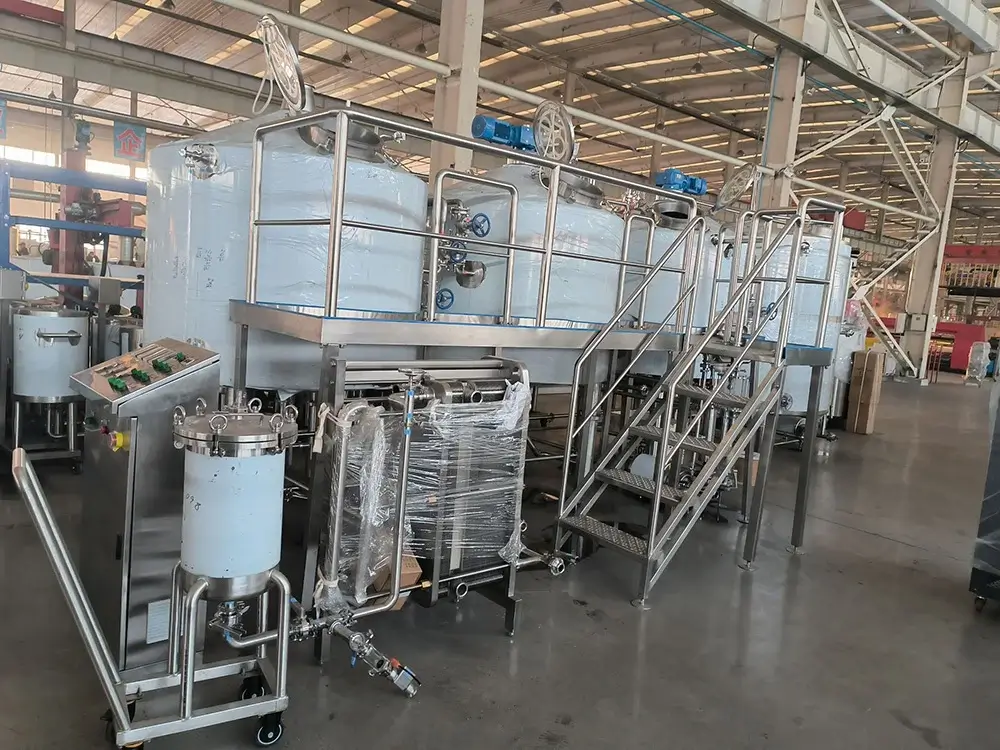
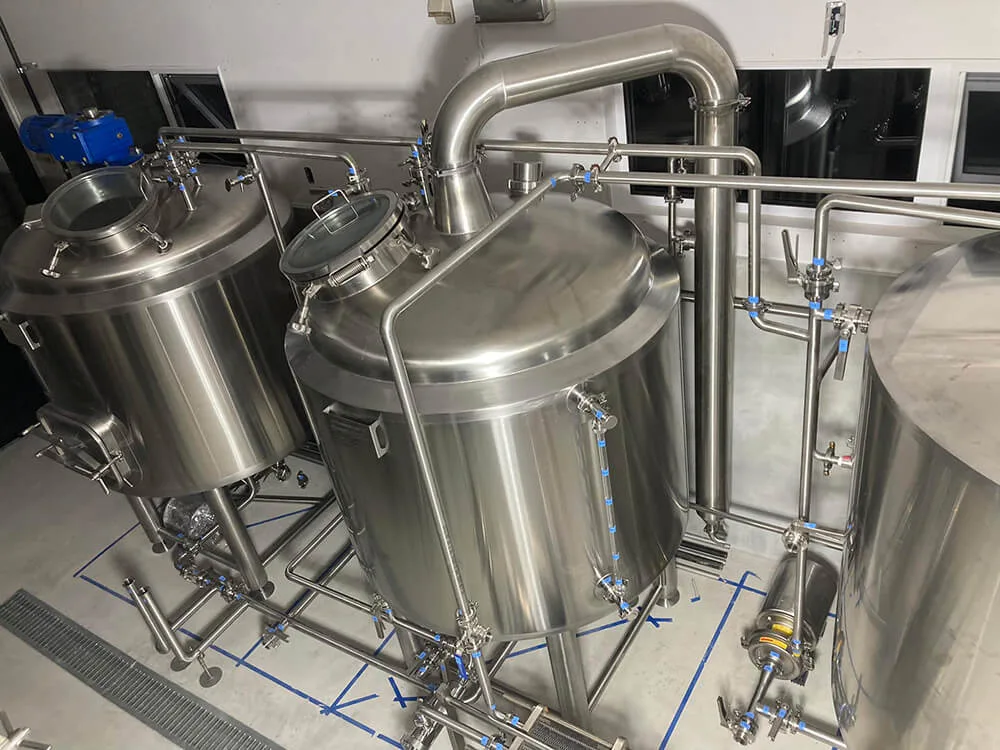
A typical craft distillery equipment setup includes:
- Milling & Mashing System – Converts raw materials into fermentable sugars
- Емкости для брожения – Where yeast transforms sugars into alcohol and flavor compounds
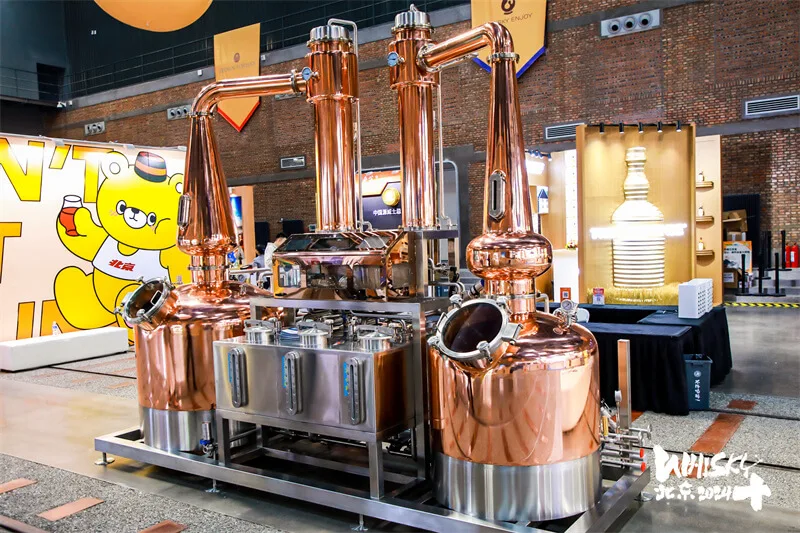
- Система дистилляции – Concentrates alcohol and shapes the final character
- Condensing & Cooling System – Ensures efficient vapor recovery
- CIP & Cleaning System – Maintains hygiene and regulatory compliance
- Система управления – Enables repeatability and process stability
Among these, the distillation system is the heart of the operation, directly defining what kind of spirits you can make and how efficiently you can make them.
2. Understanding the Three Main Types of Distillation Equipment
Before selecting a system, founders must understand the fundamental differences between still types. Each serves a different production philosophy.
Pot Still: Flavor-Driven and Traditional
Pot stills are the most traditional distillation equipment and are widely used for whisky, rum, brandy, and small-batch gin.
Key characteristics:
- Batch distillation
- Lower distillation strength per run
- Richer mouthfeel and heavier flavor compounds
- Greater influence from cuts made by the distiller
Лучше всего подходит для:
- Distilleries prioritizing flavor complexity and craftsmanship
- Producers focusing on aged spirits
- Brands that emphasize heritage and artisanal methods
Business consideration:
Pot stills require more time and labor per liter of alcohol. While excellent for premium positioning, scaling production with pot stills alone can be cost-intensive.
Column Still: Efficiency and High Purity
Column stills (also known as continuous stills or rectification columns) are designed for efficiency and high alcohol purity.
Key characteristics:
- Continuous operation
- Higher alcohol output (up to 95–96% ABV)
- Greater consistency and throughput
- Lower flavor retention compared to pot stills
Лучше всего подходит для:
- Vodka and neutral spirit production
- Large-volume distilleries
- Facilities supplying base alcohol for further flavoring
Business consideration:
Column stills maximize output and reduce cost per liter but offer less flexibility in flavor development. They are often chosen for volume-driven business models.
Hybrid Still: Flexibility for Growing Distilleries
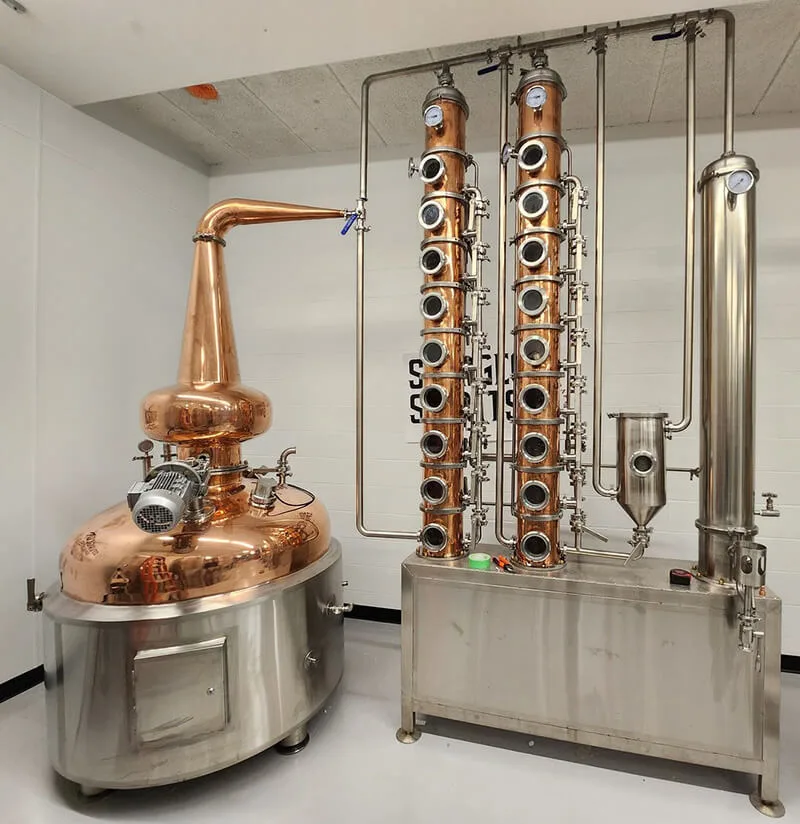
Hybrid stills combine a pot still base with a multi-plate column, offering the best of both worlds.
Key characteristics:
- Can operate as a pot still or with plates engaged
- Adjustable reflux and purity
- Suitable for multiple spirit categories
- Strong balance between flavor and efficiency
Лучше всего подходит для:
- Craft distilleries producing gin, whisky, and rum
- Startups planning product diversification
- Founders seeking future scalability
Business consideration:
Hybrid systems are often the most strategic choice for new commercial distilleries, allowing product experimentation without immediate reinvestment in new equipment.
3. Matching Distillation Equipment to Your Spirit Portfolio
Your product roadmap should guide equipment selection—not the other way around.
Джин
- Requires clean base alcohol and botanical integration
- Common configurations: hybrid still with gin basket
- Focus on precise vapor control and repeatability
Виски
- Flavor retention is critical
- Pot stills or hybrid stills with fewer plates
- Emphasis on copper contact and controlled distillation speed
Ром
- Wide stylistic range (light to heavy)
- Pot stills, column stills, or hybrid systems depending on brand vision
Vodka / Neutral Spirits
- High-purity alcohol required
- Multi-plate column systems or continuous columns preferred
Choosing equipment that limits your future product line is a costly mistake many early-stage distilleries make.
4. Capacity Planning: Think Beyond Today’s Output
One of the most common errors in distillery planning is underestimating future growth.
Key questions founders should ask:
- What is my realistic production target in 3–5 years?
- Will this system support contract distilling or private labels?
- Can fermentation capacity keep up with distillation throughput?
A properly engineered system allows:
- Modular expansion (additional fermenters or columns)
- Upgraded automation without replacing core equipment
- Increased shifts rather than complete reinvestment
Oversizing slightly at the beginning is often more economical than replacing equipment after two years.
5. Energy Source and Operating Costs
Distillation is energy-intensive, making energy selection a long-term cost factor.
Common heating options include:
- Steam heating – Most stable and scalable for commercial distilleries
- Electric heating – Suitable for small systems or limited infrastructure
- Gas-fired systems – Efficient but subject to local regulations
From a business perspective:
- Steam systems provide better control and safety
- Energy efficiency directly impacts cost per liter
- Stable heating improves product consistency
Founders should evaluate energy availability and pricing before finalizing equipment design.
6. Automation, Cleaning, and Compliance
As production grows, manual operation becomes a bottleneck.
Modern distillation systems increasingly integrate:
- PLC or PID-based control systems
- Automated temperature and reflux control
- CIP-ready designs for hygienic cleaning
Benefits include:
- Reduced operator error
- Consistent batch quality
- Easier compliance with food and alcohol regulations
Equipment that cannot be cleaned efficiently will eventually limit production or regulatory approval.
7. Distillation Equipment as a Business Asset
From an investor or founder’s perspective, distillation equipment is not an expense—it is a long-term asset.
Well-designed systems:
- Retain resale value
- Support multiple product categories
- Reduce operating risk
- Improve brand credibility during audits and partnerships
Poorly planned equipment, on the other hand, leads to:
- Production inefficiencies
- Inconsistent quality
- Unexpected reinvestment
- Growth limitations
8. A Practical Approach to Distillery Equipment Solutions
Successful distilleries rarely purchase equipment in isolation. Instead, they adopt a solution-based approach, where distillation equipment is engineered around:
- Target spirit styles
- Planned capacity
- Local regulations
- Expansion strategy
At Meto, distillation systems are designed as part of an integrated production solution—balancing flavor goals, operational efficiency, and long-term scalability. Each system is customized to fit the distillery’s current needs while remaining adaptable for future growth.
Conclusion: A Strategic Decision, Not a Technical One
Choosing distillation equipment is not just a technical challenge—it is a strategic business decision that shapes your brand, margins, and growth potential.
By understanding still types, production goals, and operational realities, founders can avoid costly mistakes and build distilleries that are both creative and commercially sustainable.
The right distillation system does more than produce spirits.
It supports your vision, protects your investment, and grows with your business.