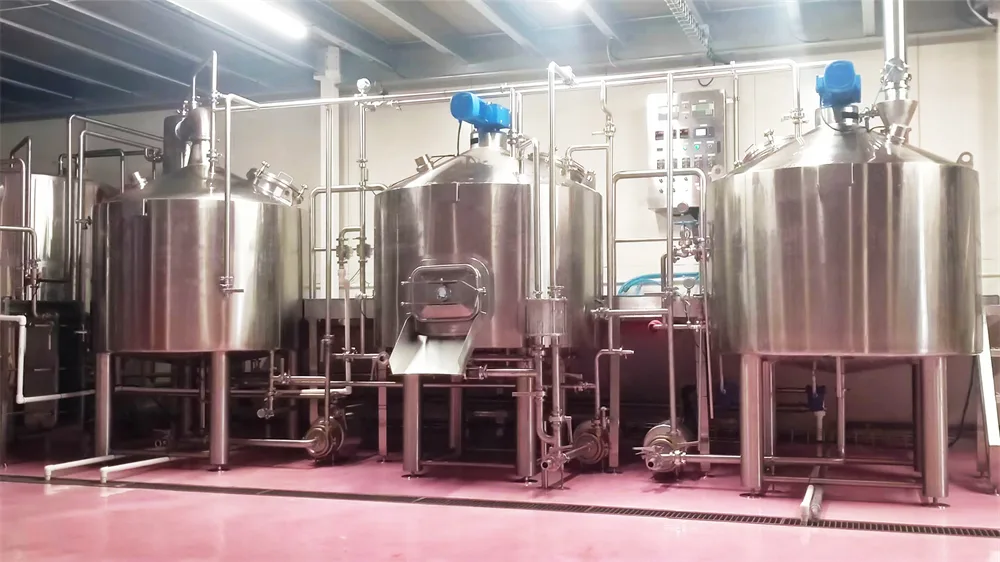
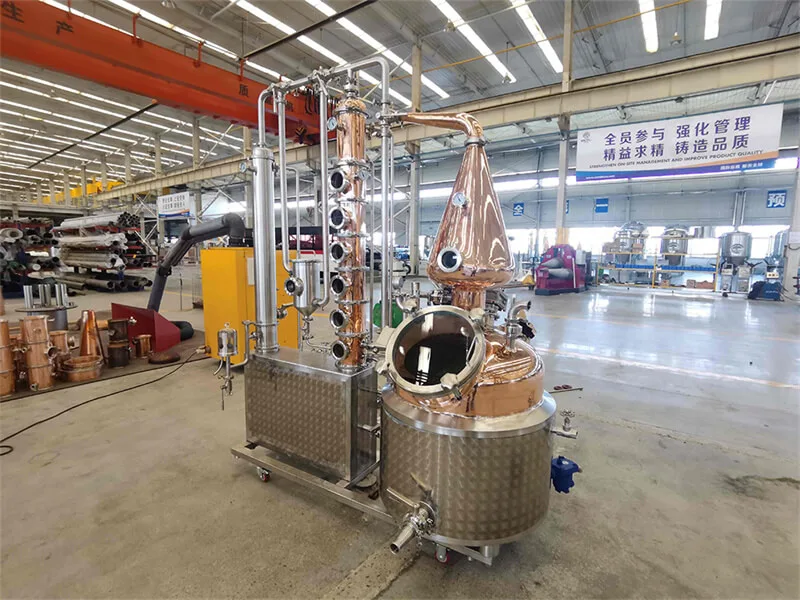
A modern 1000L distillation system is no longer a fixed-function setup. Instead, it is an engineered platform that integrates pot still and column still technologies into a modular structure.
For international distilleries, the shift toward modular distillation system design enables:
- Flexible production across multiple spirit categories
- Scalable system expansion
- Reduced long-term investment costs
A well-designed distillation system allows seamless switching between pot still and column still operation without compromising performance.
Modular Architecture of a 1000L Distillation System
The core strength of a modern distillation system lies in its modular configuration. Each functional unit is engineered to operate independently while maintaining full system integration.
1. Distillation Kettle (Pot Still Base Module)
The pot still module serves as the thermal and process foundation of the distillation system.
Technical selling points:
- Optimized vessel geometry for uniform heat distribution
- Optional internal agitator for high-viscosity mash
- Copper hybrid design for improved catalytic reaction
- Engineered for stable vapor generation
Within the distillation system, the pot still defines baseline flavor structure and batch stability.
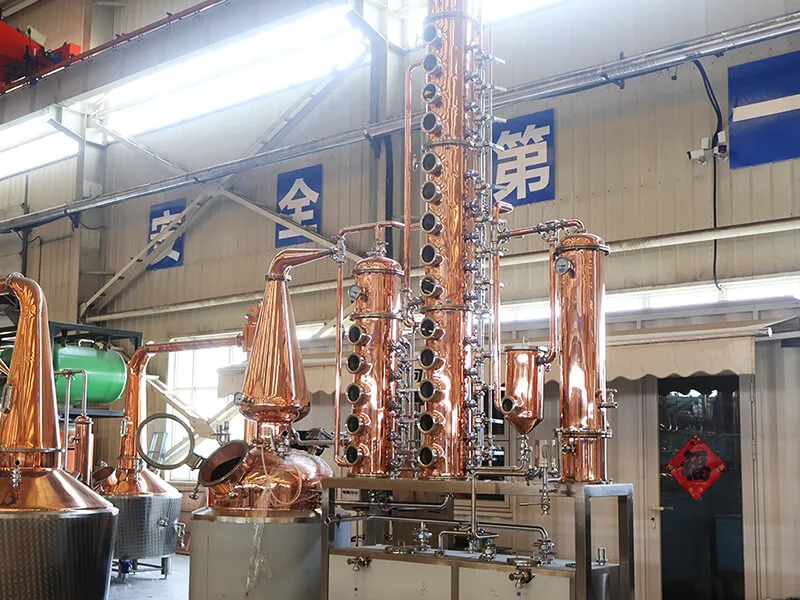
2. Rectification Column (Column Still Module)
The column still module upgrades the distillation system from simple separation to precision rectification.
Technical selling points:
- Multi-stage plate structure (bubble cap / sieve tray)
- Modular column sections for flexible height adjustment
- Designed for high-efficiency vapor-liquid contact
- Supports high-purity alcohol production
A column still transforms the distillation system into a multi-purpose production unit capable of both flavored and neutral spirits.
3. Reflux Control Module
Reflux control is the core mechanism that links pot still and column still performance within the distillation system.
Technical selling points:
- High-efficiency dephlegmator design
- Adjustable cooling water flow for reflux ratio control
- Stable temperature gradient across column still plates
- Enables dynamic switching between product styles
This module is critical for fine-tuning the distillation system output.
4. Condensation & Cooling Module
The condensation system ensures reliable conversion of vapor into liquid across all operating modes.
Technical selling points:
- Shell-and-tube heat exchanger for efficient cooling
- Low water consumption design
- Stable operation under high vapor load
- Compatible with both pot still and column still output
A robust condenser guarantees the safety and efficiency of the entire distillation system.
5. CIP Cleaning Module (Integrated Hygiene System)
In a multi-functional distillation system, cleaning is a key technical requirement.
Technical selling points:
- Automated CIP spray ball coverage
- Internal circulation cleaning loops
- Reduced downtime between product changeovers
- Prevention of flavor cross-contamination
A clean distillation system ensures consistent product quality and compliance with international standards.
Integrated Pot Still & Column Still Operation Modes
A 1000L distillation system supports multiple operation modes through modular integration.
Pot Still Mode
- Column still module bypassed
- Minimal reflux
- Maximum flavor retention
Used for whiskey, rum, and other full-bodied spirits.
Column Still Mode
- Full column engagement
- High reflux ratio
- Maximum alcohol purity
Ideal for vodka and neutral spirits.
Hybrid Mode
- Partial column utilization
- Controlled reflux
- Balanced flavor and purity
This flexibility allows a single distillation system to meet diverse production requirements.
Engineering Advantages of Modular Distillation Systems
Compared to traditional fixed systems, a modular distillation system offers significant engineering benefits:
1. Scalability
- Add or remove column still sections
- Upgrade pot still capacity in future
- Expand functionality without replacing the entire distillation system
2. Maintenance Efficiency
- Individual module replacement
- Reduced downtime
- Simplified troubleshooting
3. Process Flexibility
- Rapid switching between pot still and column still modes
- Adaptation to different recipes and raw materials
- Support for experimental and commercial production
4. Cost Optimization
- Lower initial investment compared to multiple systems
- Reduced installation complexity
- Long-term operational savings
Automation Integration in Distillation Systems
Modern distillation systems increasingly incorporate automation to enhance control and repeatability.
Technical selling points:
- PLC-based control of pot still and column still operations
- Automated reflux ratio adjustment
- Real-time monitoring of temperature and pressure
- Recipe-based operation for consistent output
Automation elevates the distillation system from manual equipment to a smart production system.
Key Technical Differentiators in a High-Quality Distillation System
When evaluating a 1000L distillation system, the following factors distinguish high-performance designs:
- Precision engineering of pot still geometry
- Efficient plate design in column still modules
- Stable and responsive reflux control
- High-quality welding and material standards
- Integration between modules rather than isolated components
A superior distillation system is defined by how well these elements work together.
Conclusion: Modular Distillation Systems as a Long-Term Investment
A 1000L distillation system that integrates pot still and column still modules represents a future-ready solution for modern distilleries.
By combining modular engineering, process flexibility, and automation, such a distillation system provides:
- Multi-product capability
- Scalable production
- Consistent product quality
For international buyers, choosing a modular distillation system is not just an equipment decision—it is a strategic investment in operational efficiency and market adaptability.
👉 Contacte-nos hoje para um projeto de sistema de sala de brassagem personalizado, adaptado aos seus objectivos de produção, orçamento e planos de expansão futuros.