Author: METO Senior Brewery Engineering Team
Technical Review: Certified Master Brewer & Process Automation Specialist
Executive Summary
Fermentation capacity is one of the most important factors determining the production efficiency of a commercial brewery. Proper cellar sizing requires more than calculating the total volume of fermentation tanks.
Key considerations include:
- Core Sizing Formula: Required Cellar Capacity = Daily Wort Input × Total Tank Residence Time × 1.15.
- Process Yield: Account for approximately 5%–10% process losses during fermentation, trub removal, dry hopping, and filtration.
- Brewhouse-to-Fermenter Matching: Configure fermentation tanks as practical multiples of brewhouse knockout volume to improve batch scheduling.
- Cooling and CIP Capacity: Adequate glycol cooling and efficient CIP turnaround are essential for maintaining continuous production.
Table of Contents
- Understanding Fermentation Capacity in a Commercial Brewery
- How to Calculate Required Fermentation Capacity
- Fermentation and Maturation Residence Time
- Determining Fermentation Tank Size and Quantity
- Matching Fermentation Capacity with Brewhouse Output
- Five Critical Engineering Factors Affecting Throughput
- Strategies to Optimize Fermentation Tank Turnover
- Common Mistakes in Fermentation Capacity Planning
- How METO Designs Commercial Fermentation Systems
- Frequently Asked Questions
1. Understanding Fermentation Capacity in a Commercial Brewery
In commercial brewery engineering, confusing installed fermentation volume with actual annual production is a common reason for unexpected bottlenecks or excessive equipment investment.
The overall production capacity of a brewery depends on three interconnected factors:
Brewhouse Batch Volume → Daily Wort Production → Fermentation Tank Turnover → Annual Beer Output
Each stage plays a different role:
- Brewhouse Capacity: Determines how much wort can be produced per batch and per brewing day.
- Fermentation Working Capacity: Determines how much wort and beer can be processed simultaneously.
- Tank Turnover Rate: Determines how frequently fermentation tanks become available for new batches.
To plan accurately, two fundamental metrics must be distinguished.
1.1 Installed Working Fermentation Capacity
Installed working capacity refers to the total usable liquid volume across all active fermentation vessels, excluding the required headspace.
For example, a brewery equipped with ten 10,000L working-volume unitanks has a total installed working capacity of 100,000L.
The nominal geometric volume of each vessel must be larger than its working volume to accommodate krausen, foam formation, and process requirements.
1.2 Annual Fermentation Throughput
Annual fermentation throughput refers to the total volume of beer processed through the fermentation system over one year.
It depends on:
- Total installed working volume.
- Fermentation and maturation residence time.
- Cleaning and transfer time.
- Production scheduling efficiency.
- Maintenance and operational downtime.
For example, the same fermentation cellar may support significantly different annual production depending on whether it primarily produces fast-turnaround ales or longer-maturing lagers.
This is why fermentation capacity should always be evaluated in relation to the brewery’s actual product portfolio and production schedule.
2. How to Calculate Required Fermentation Capacity
To design an efficient fermentation cellar, start with the annual production target and work backward through the production process.
Step 1: Calculate Target Daily Finished Beer Volume
The first step is to determine the average finished beer volume required per operating day.
Formula:
Daily Finished Volume = Annual Production Target ÷ Annual Operating Days
For example, assume a commercial brewery targets 1,200,000L of packaged beer annually and operates 300 production days per year.
1,200,000L ÷ 300 = 4,000L/day
The brewery therefore needs to produce an average of 4,000L of finished beer per operating day.
Step 2: Account for Process Yield Losses
The wort volume entering fermentation is generally higher than the final packaged beer volume.
Process losses may occur during:
- Wort cooling and transfer.
- Trub separation and removal.
- Yeast harvesting.
- Dry hopping and beer clarification.
- Filtration and packaging preparation.
For preliminary planning, assume a brewhouse-to-packaged-beer yield of 95%.
Formula:
Required Daily Wort Input = Daily Finished Volume ÷ Process Yield
4,000L ÷ 0.95 = 4,211L/day
The brewery therefore needs approximately 4,211L of wort input per production day.
The actual yield should be established from the brewery’s process data and equipment configuration.
Step 3: Calculate Total Tank Residence Time
Fermentation tanks remain occupied throughout primary fermentation, conditioning, transfer, and cleaning.
For this example, assume an average tank occupancy period of 18 days.
Formula:
Theoretical Cellar Capacity = Daily Wort Input × Total Tank Occupancy Days
4,211L/day × 18 days = 75,798L
The brewery requires approximately 75,800L of usable fermentation capacity before applying an engineering allowance.
Step 4: Apply an Engineering Flexibility Factor
Commercial breweries need additional capacity to accommodate:
- Seasonal production fluctuations.
- Delayed fermentation.
- Tank maintenance.
- CIP scheduling conflicts.
- Changes in product mix.
- Unexpected production demand.
Applying a 15% planning allowance:
Recommended Working Capacity = Theoretical Cellar Capacity × 1.15
75,798L × 1.15 = 87,168L
Calculation Result
Recommended installed working fermentation capacity: approximately 88,000–90,000L.
The 15% allowance is an illustrative planning assumption. Actual reserve capacity should be determined according to production variability and the brewery’s operating strategy.
3. Fermentation and Maturation Residence Time
A fermentation vessel is occupied for much longer than the active sugar attenuation period.
Therefore, cellar sizing must account for the complete tank occupancy cycle.
3.1 Typical Fermentation Tank Occupancy Timeline
An illustrative 18-day ale production cycle may include:
| Production Stage | Typical Duration |
|---|---|
| Wort knockout and pitching | 0.5 day |
| Primary fermentation | 4–7 days |
| Diacetyl rest and VDK reduction | 2–3 days |
| Cold crashing and conditioning | 3–6 days |
| Beer transfer and emptying | 0.5 day |
| CIP and sanitation | 0.5–1 day |
The actual duration varies according to beer style, yeast strain, original gravity, temperature profile, and quality requirements.
3.2 Differences Between Ale and Lager Production
| Production Stage | Ale | ラガー |
|---|---|---|
| Primary fermentation | 4–7 days | 7–12 days |
| ジアセチル | 2–3 days | 3–5 days |
| Cold conditioning | 3–6 days | 10–21 days |
| Transfer and CIP | 1–1.5 days | 1–1.5 days |
As a result, an illustrative total tank occupancy period may be:
- Ales: 11–18 days.
- Lagers: 22–40 days.
Theoretical annual turnover is approximately 20–33 cycles for ales and 9–16 cycles for lagers, assuming the respective residence periods remain constant and tanks operate continuously.
This difference has a significant impact on fermentation tank investment.
Breweries producing a high proportion of lager beers generally need more installed fermentation capacity to achieve the same annual output.
4. Determining Fermentation Tank Size and Quantity
After calculating the required working volume, the next step is selecting the appropriate tank size and quantity.
Assuming a required working capacity of approximately 90,000L, several configurations are possible.
4.1 Fermentation Tank Configuration Comparison
| 構成 | Tank Working Volume | Quantity | Total Working Volume |
|---|---|---|---|
| Option A | 5,000L | 18 | 90,000L |
| Option B | 10,000L | 9 | 90,000L |
| Option C | 15,000L | 6 | 90,000L |
| Option D | 20,000L | 5 | 100,000L |
4.2 How to Choose the Right Configuration
Option A: Smaller Fermentation Tanks
Best suited to taproom breweries, seasonal production, and breweries with a wide variety of beer styles.
メリット
- High production flexibility.
- Easier separation of specialty batches.
- Better control over small-volume products.
考慮事項:
- More valves and pipeline connections.
- More temperature sensors and control points.
- Higher cleaning and automation complexity.
Option B: Medium-Sized Fermentation Tanks
A balanced solution for growing regional craft breweries.
メリット
- Good balance between flexibility and operating efficiency.
- Suitable for multiple brewhouse batches.
- Moderate pipeline and utility requirements.
Option C: Larger Fermentation Tanks
Suitable for breweries with relatively stable production demand and standardized recipes.
メリット
- Fewer vessels for the same total working volume.
- More centralized utility connections.
- Lower equipment complexity per unit of installed capacity.
Option D: High-Capacity Fermentation Tanks
Suitable for high-volume commercial breweries and standardized beer production.
メリット
- High-volume batch processing.
- Efficient use of cellar floor space.
- Potentially lower installed cost per unit of capacity.
考慮事項:
- Less flexibility for small batches.
- Higher individual vessel cooling and structural requirements.
- Greater impact when a large tank is unavailable.
4.3 METO Hybrid Configuration Recommendation
For breweries producing both core products and seasonal beers, a mixed tank configuration can provide better operational flexibility.
An illustrative configuration includes:
- 4 × 10,000L conical fermentation tanks for flagship beers.
- 4 × 5,000L conical fermentation tanks for seasonal products.
- 2 × 10,000L horizontal lagering tanks for dedicated maturation.
This configuration separates primary fermentation and maturation capacity, allowing breweries to allocate conical vessels more efficiently.
The final configuration should be verified against the brewing schedule and actual process requirements.
5. Matching Fermentation Capacity with Brewhouse Output
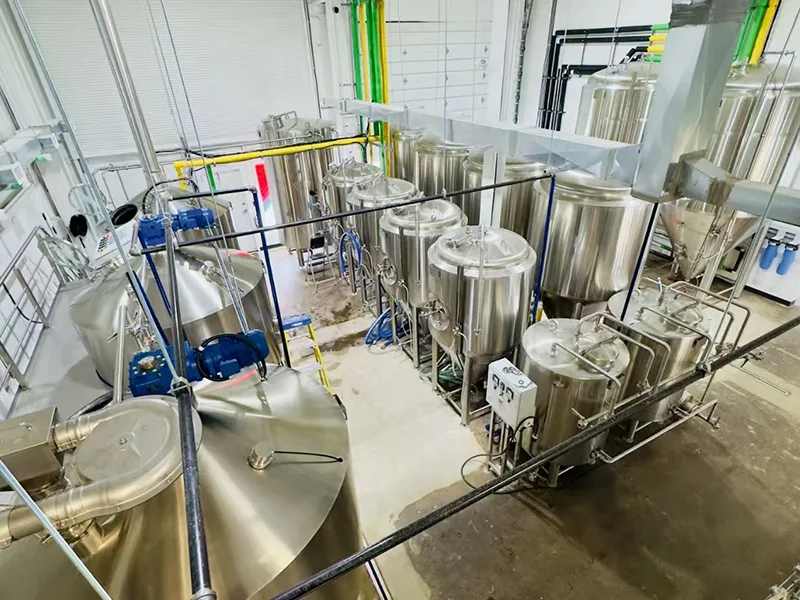
One of the most important engineering considerations is matching brewhouse knockout volume with fermentation tank working volume.
A fermentation cellar may have sufficient total volume but still operate inefficiently if tank sizes do not align with the brewhouse batch schedule.
5.1 The Brewhouse-to-Fermenter Batch Multiple
For practical production scheduling, fermentation tank working volume can be configured as a multiple of the brewhouse knockout volume.
Common configurations include:
- 1× Batch: One brewhouse batch fills one fermentation tank.
- 2× Batch: Two brewhouse batches fill one fermentation tank.
- 3× Batch: Three brewhouse batches fill one fermentation tank.
- 4× Batch: Four brewhouse batches fill one fermentation tank.
This approach helps simplify wort transfer and reduce partially filled vessels.
5.2 Example: 5,000L Four-Vessel Brewhouse
Consider a commercial brewery equipped with a 5,000L four-vessel brewhouse.
Assume the system operates four batches per day:
| Batch | Brewing Schedule | Wort Volume |
|---|---|---|
| Batch 1 | 06:00 | 5,000L |
| Batch 2 | 10:00 | 5,000L |
| Batch 3 | 14:00 | 5,000L |
| Batch 4 | 18:00 | 5,000L |
| Total | 20,000L/day |
One possible configuration is to combine four batches in one 20,000L working-volume fermentation tank.
This allows the brewery to consolidate daily wort production into a larger fermentation vessel.
However, the tank filling schedule must consider yeast pitching, oxygenation, temperature control, and wort residence time.
Where multiple batches are combined, they should be processed within a validated production window to maintain consistent fermentation conditions and beer quality.
5.3 Selecting the Appropriate Batch Multiple
| Tank-to-Brewhouse Ratio | 代表的な用途 |
|---|---|
| 1× | Brewpubs, pilot batches, specialty beers |
| 2× | Small and medium-sized craft breweries |
| 3× | Growing commercial breweries |
| 4× | Large-volume commercial production |
The most suitable configuration depends on daily brewing frequency, batch transfer intervals, product consistency requirements, and cellar scheduling.
6. Five Critical Engineering Factors Affecting Real Throughput
Total fermentation tank volume alone does not determine the actual production capacity of a brewery.
Several engineering factors directly affect tank turnover and overall production efficiency.
6.1 Glycol Chiller Peak Load Capacity
Fermentation generates heat through yeast activity. The glycol cooling system must remove this heat while maintaining the required fermentation temperature.
The cooling system should account for:
- Peak heat generation during active fermentation.
- Simultaneous cooling demand across multiple tanks.
- Cold crashing requirements.
- Ambient temperature conditions.
- Tank insulation performance.
- Cooling demand from other brewery equipment.
A brewery with sufficient tank volume may still experience production bottlenecks if the glycol chiller cannot support simultaneous peak cooling loads.
For larger commercial systems, cooling distribution should also consider dedicated pumps, appropriately sized headers, control valves, and independent jacket zones.
6.2 Vessel Geometry and Cone Angle
Fermentation tank geometry affects heat transfer, yeast sedimentation, cleaning performance, and vessel operation.
Important design considerations include:
- Cylindrical body height and diameter.
- Cone angle.
- Cooling jacket distribution.
- Insulation thickness.
- Internal surface finish.
- Pressure design and working pressure.
Commonly used cone configurations include approximately 60° cones, although the final geometry should be selected according to tank capacity, yeast characteristics, and discharge requirements.
The height-to-diameter ratio should also be evaluated because hydrostatic pressure and thermal conditions can influence fermentation behavior.
6.3 Dedicated Bright Beer Tanks (BBTs)
Using fermentation tanks for both fermentation and final beer holding can increase tank occupancy time.
Dedicated Bright Beer Tanks provide a separate vessel for beer clarification, carbonation, and packaging preparation.
A typical process arrangement is:
Fermentation Tank → Beer Transfer → Bright Beer Tank → Packaging Line
This allows the fermentation tank to be cleaned and prepared for the next batch while the finished beer remains in the BBT.
The result can be improved fermentation tank turnover without immediately purchasing additional conical fermenters.
The required BBT quantity depends on packaging frequency, batch size, and the time required for beer storage and carbonation.
6.4 Automated CIP Flow Dynamics
Cleaning time directly affects tank availability.
A properly designed CIP system should consider:
- CIP pump capacity.
- Cleaning solution flow rate.
- Spray device coverage.
- Pipeline diameter and pressure loss.
- Cleaning temperature and chemical concentration.
- Complete drainage and sanitation.
Adequate flow velocity is important for pipeline cleaning, while tank cleaning performance depends on the spray device, vessel geometry, and cleaning conditions.
Automated CIP sequences can help standardize cleaning operations and reduce unnecessary downtime.
6.5 Automation and Sensor Integration
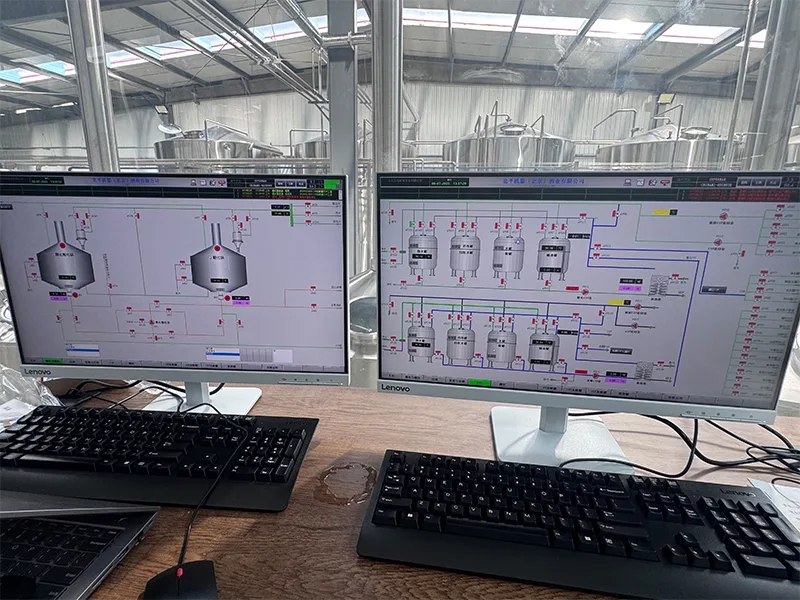
PLC-based automation improves the visibility and consistency of fermentation operations.
Depending on system configuration, key functions may include:
- Individual tank temperature monitoring.
- Automatic glycol valve control.
- Programmable fermentation temperature profiles.
- Tank pressure monitoring.
- Batch status tracking.
- CIP sequence management.
- Alarm notifications and operating records.
For breweries operating multiple fermentation tanks, centralized monitoring can reduce manual workload and improve production coordination.
7. Strategies to Optimize Fermentation Tank Turnover
Once the fermentation system has been sized, operational optimization can further improve production efficiency.
7.1 Separate Fermentation and Maturation
Use conical unitanks for primary fermentation and transfer beer to dedicated horizontal lagering tanks when the process allows.
This approach can release conical fermenters earlier while maintaining the required maturation period.
It is particularly useful for breweries producing larger volumes of lager beer.
7.2 Optimize Beer Clarification
Depending on product specifications, a centrifuge or other clarification equipment may help reduce the time required for downstream beer processing.
However, clarification equipment does not automatically eliminate the need for maturation.
Any reduction in tank occupancy must be validated against beer stability, flavor, clarity, and quality requirements.
7.3 Stagger Brewhouse Scheduling
Avoid concentrating all brewing and tank filling operations within the same short period.
A staggered schedule helps distribute:
- Fermentation tank filling.
- Beer transfer.
- Packaging demand.
- CIP operations.
- Cooling loads.
This improves the utilization of both the cellar and supporting utilities.
7.4 Prepare Utility Connections for Expansion
For breweries planning phased development, utility infrastructure should be designed with future expansion in mind.
Consider reserving capacity or installation space for:
- Glycol supply and return headers.
- CIP pipelines.
- CO₂ distribution.
- Electrical connections.
- Drainage systems.
- Additional fermentation tanks.
This approach can reduce future modification costs and minimize production interruptions during expansion.
8. Common Mistakes in Fermentation Capacity Planning
Even a well-equipped brewery can experience production limitations if its fermentation system is not properly engineered.
Mistake 1: Sizing Tanks Based Only on Nominal Volume
A 10,000L gross-volume vessel does not necessarily provide 10,000L of usable fermentation capacity.
Headspace must be considered when determining the vessel’s actual working volume.
Mistake 2: Ignoring Installation Height and Maintenance Clearance
Tank installation requires sufficient space for:
- Manway access.
- Top-mounted instrument maintenance.
- Valve and pipeline connections.
- Lifting and rigging operations.
- Vessel installation and future replacement.
Ceiling height and equipment clearance should be confirmed during the layout design stage.
Mistake 3: Underestimating Glycol Pipeline Capacity
Undersized glycol headers can cause excessive pressure loss and insufficient flow to distant fermentation tanks.
The cooling distribution system must be designed according to simultaneous demand and the hydraulic characteristics of the entire pipeline network.
Mistake 4: Neglecting Yeast Harvesting and Management
Yeast harvesting schedules should be coordinated with fermentation and cleaning operations.
Prolonged storage of yeast under unsuitable conditions can reduce viability and affect subsequent fermentation performance.
9. How METO Designs Commercial Fermentation Systems
METO provides customized fermentation equipment and integrated brewing systems for craft breweries and industrial beer production facilities.
Our engineering approach considers not only individual tank specifications but also the relationship between fermentation capacity, brewhouse output, cooling utilities, CIP systems, and production automation.
9.1 Fermentation Tank Engineering
Depending on project requirements, tank configurations can include:
- 素材: Food-grade SUS304 or SUS316L stainless steel.
- 内部仕上げ: Sanitary polishing, with surface roughness specified according to project requirements.
- Cooling Jacket: Single-zone or multi-zone dimple jacket configurations.
- 断熱材: Polyurethane insulation with customized thickness.
- Tank Geometry: Cylindrical-conical fermentation vessel design.
- Cleaning: CIP spray devices and sanitary connections.
- Instrumentation: Temperature sensors, pressure gauges, and control valves.
Pressure ratings, materials, welding procedures, surface finishes, and applicable certifications are confirmed according to the individual project specification.
9.2 Integrated Brewery Engineering
Beyond manufacturing fermentation tanks, METO can coordinate the design and supply of:
- Brewhouse systems.
- Fermentation and maturation tanks.
- Bright Beer Tanks.
- Glycol cooling systems.
- CIP cleaning systems.
- Process pipelines and valves.
- PLC automation and control systems.
From initial production planning and equipment fabrication to piping pre-assembly, installation, and commissioning, METO supports customers throughout the brewery project lifecycle.
Whether you are planning a 1,000L craft brewery, a 5,000L commercial brewing system, or a larger industrial production facility, the fermentation cellar can be configured according to your actual production targets and future expansion requirements.
Planning a commercial brewery project? お問い合わせ to discuss a customized fermentation system based on your brewhouse capacity, beer styles, and annual production target.
10. Frequently Asked Questions
Q1: What is the standard ratio of brewhouse capacity to fermentation capacity?
There is no universal fixed ratio. Required fermentation capacity depends on daily brewhouse output, fermentation residence time, beer style, and production scheduling.
The most reliable approach is to calculate cellar capacity using daily wort input and total tank occupancy time.
Q2: How much headspace is required in a commercial fermenter?
Headspace depends on beer style, fermentation characteristics, vessel geometry, and process conditions.
Many commercial fermentation vessels reserve approximately 20%–25% of nominal volume as headspace, although highly active fermentations may require additional allowance.
Q3: How does adding a Bright Beer Tank increase fermentation capacity?
A dedicated BBT allows finished beer to be transferred out of the fermentation tank before packaging.
This releases the conical fermenter for cleaning and the next production batch while the beer remains in the BBT for carbonation or packaging preparation.
Q4: Can different-sized fermenters be used with the same brewhouse?
Yes. Combining different fermentation tank sizes allows breweries to handle standard production batches, seasonal products, and specialty beers more flexibly.
Tank working volumes should be coordinated with brewhouse knockout volume and the production schedule.
Q5: How do I calculate the glycol chiller capacity required for a brewery cellar?
Glycol chiller sizing requires an assessment of simultaneous fermentation heat loads, cold crashing demand, ambient conditions, insulation, piping losses, and other connected cooling equipment.
The calculation should be based on the maximum expected coincident cooling load rather than simply adding the nominal volume of all fermentation tanks.
Q6: Can fermentation capacity be expanded without replacing the brewhouse?
Yes. Additional fermentation tanks can increase cellar capacity if the existing brewhouse can supply enough wort to utilize them.
However, glycol cooling, CIP, utilities, floor space, and packaging capacity must also be evaluated before expansion.
結論
Calculating fermentation capacity accurately is essential for building an efficient and scalable commercial brewery.
The design process should begin with the annual production target, daily wort input, process yield, and total tank residence time. These figures determine the required working fermentation volume and provide the basis for selecting tank sizes and quantities.
However, real production efficiency depends on more than installed tank volume. Brewhouse batch matching, glycol cooling capacity, CIP turnaround, BBT configuration, and production scheduling all influence the actual throughput of the fermentation cellar.
By treating fermentation equipment as part of an integrated brewery production system, breweries can avoid unnecessary investment, reduce production bottlenecks, and prepare for long-term expansion.
METO supports commercial breweries with customized fermentation tanks and integrated brewing systems engineered around real production requirements.