Understanding the Role of Fermentation Equipment in Commercial Brewing
In a commercial brewery, fermentation is where raw wort is transformed into finished beer. While brewhouse design determines wort quality, the fermentation system directly influences yeast performance, flavor consistency, production efficiency, and operating costs.
For brewery owners planning a new facility or expanding existing production, selecting the right brewery fermentation tank is a long-term engineering decision rather than a simple equipment purchase.
The two most common fermentation vessel designs are conical fermenters and cylindrical fermentation tanks. Cylindrical tanks represent a traditional approach that has been used in various brewing styles for decades, while conical fermenters have become the standard configuration for most commercial craft breweries because of their improved yeast management, easier cleaning, and higher production flexibility.
As a professional fermenter equipment manufacturer, METO designs and manufactures stainless steel fermentation systems for breweries worldwide. The choice between different fermentation tank designs depends on production scale, beer style, automation requirements, and future expansion plans.
What Is a Conical Fermenter?
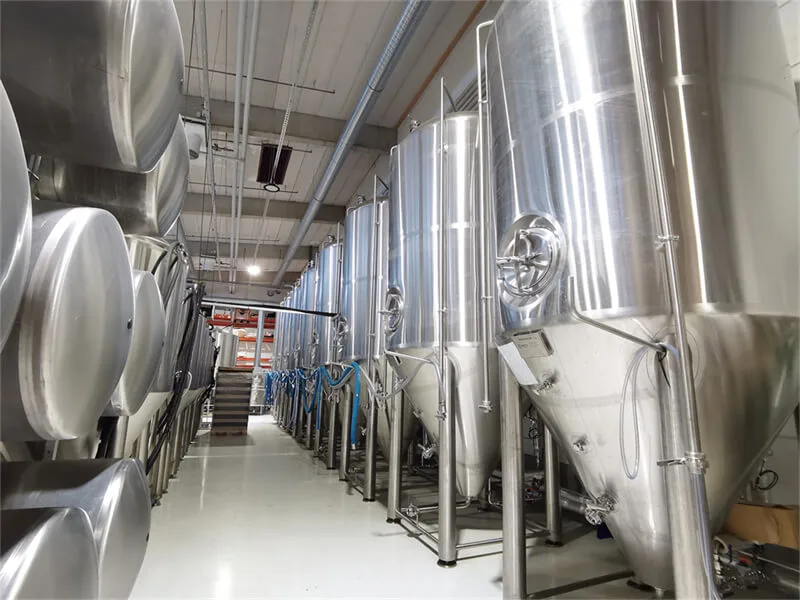
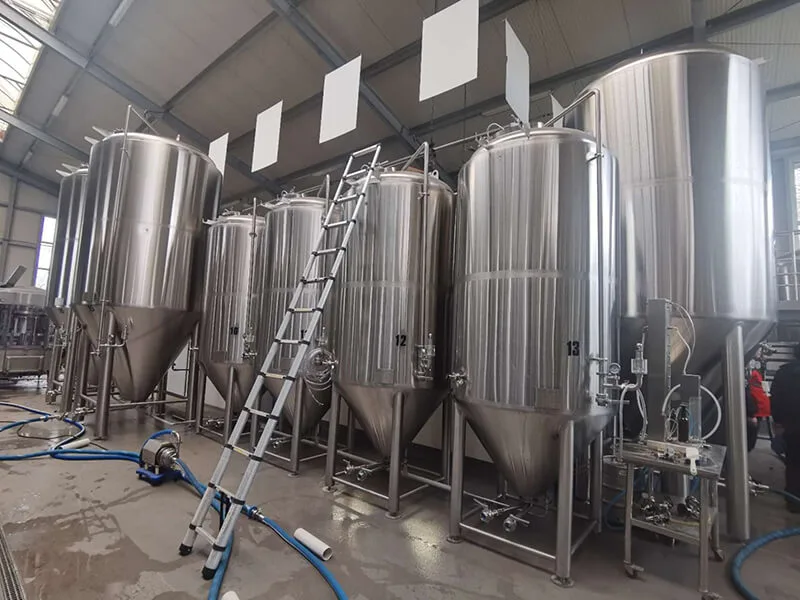
A conical fermenter, also known as a conical fermentation tank or CCT (Cylindroconical Tank), is a stainless steel vessel with a cone-shaped bottom section, typically designed with a cone angle between 60° and 70°.
The cone structure is not only a visual feature. It is an important engineering design that uses gravity to separate yeast, proteins, hop particles, and other solids during fermentation.
As fermentation progresses, suspended particles naturally move toward the cone bottom. Brewers can then remove sediment through the bottom outlet and collect clean yeast for reuse.
Compared with traditional fermentation vessels, a conical fermenter allows multiple processes to be completed inside one closed tank:
- Primary fermentation
- Secondary maturation
- Cold conditioning
- Natural carbonation
- Dry hopping
- Yeast harvesting
This reduces product transfer, minimizes oxygen exposure, and improves batch-to-batch consistency.
For this reason, conical fermenters have become the preferred choice for craft brewery equipment, microbrewery projects, brewpubs, and commercial beer production facilities.
Engineering Design Features of Commercial Stainless Steel Fermenters
A professional stainless steel fermenter is more than a pressure vessel. Its design must consider sanitation, heat transfer efficiency, mechanical strength, and long-term operating reliability.
Food-Grade Stainless Steel Construction
Most commercial fermentation tanks are manufactured using SUS304 stainless steel, while SUS316L stainless steel is often selected for applications requiring higher corrosion resistance.
Material selection affects:
- Tank durability
- Cleaning performance
- Surface hygiene
- Resistance to acidic environments
For breweries producing sour beer, specialty beverages, or frequent cleaning cycles, 316L stainless steel can provide additional protection against corrosion.
At METO, fermentation tanks are manufactured according to food-grade sanitary requirements. The inner surface is processed through polishing and passivation procedures to reduce surface roughness and prevent microbial attachment.
Cooling Jacket Design and Temperature Control
Fermentation temperature directly affects yeast activity and beer profile.
A properly designed fermentation tank requires efficient heat exchange to maintain stable temperature throughout the fermentation process.
Commercial conical fermenters typically use:
- Dimple cooling jackets
- Multiple cooling zones
- Glycol circulation systems
- PU insulation layers
The cooling jacket design must provide even heat transfer without creating temperature differences inside the tank.
For example, METO fermentation tanks use optimized jacket layouts based on tank diameter and working volume. This helps maintain consistent fermentation conditions whether the tank capacity is 500L, 2000L, or larger commercial volumes.
Stable temperature control is especially important for:
- Lager fermentation
- IPA production
- High-gravity beer
- Seasonal production schedules
Pressure-Rated Design for Professional Brewing Applications
Many commercial breweries require pressure-capable fermentation equipment.
A pressure-rated conical fermenter allows brewers to:
- Perform closed fermentation
- Reduce oxygen exposure
- Carbonate beer inside the tank
- Improve product stability
- Reduce transfer operations
Typical commercial fermenters are designed according to required working pressure and safety standards.
Depending on market requirements, fermentation tanks may need to comply with certifications such as:
- CE / PED requirements for European markets
- ASME standards for North American applications
- Food-grade manufacturing requirements
As a global fermenter equipment manufacturer, METO provides customized pressure vessel design according to customer location, production requirements, and regulatory standards.
What Is a Cylindrical Fermentation Tank?
A cylindrical fermentation tank is a traditional fermentation vessel with a flat or slightly curved bottom.
Before the development of modern conical fermenters, many breweries used cylindrical tanks because they were simpler to manufacture and operate.
Although their application has decreased in commercial brewing, cylindrical tanks are still used in certain situations.
代表的な用途としては、次のようなものがあります:
- Traditional lager fermentation
- Open fermentation styles
- Small experimental batches
- Breweries focusing on historical brewing methods
The main difference is the way yeast and sediment are handled.
In a cylindrical tank, sediment spreads across the bottom surface. Brewers usually need additional steps to remove solids or transfer beer between vessels.
This makes the design less efficient for breweries that require high production efficiency and frequent batch turnover.
Conical Fermenter vs. Cylindrical Tank: Key Differences
| 特徴 | Conical Fermenter | Cylindrical Fermentation Tank |
| Bottom design | 60–70° cone bottom | Flat or shallow bottom |
| Yeast collection | Efficient gravity separation | Sediment spreads across bottom |
| Yeast reuse | Easy collection of cleaner yeast | More difficult separation |
| Fermentation type | Suitable for ale and lager | Mainly traditional applications |
| Pressure fermentation | Common design feature | Less common |
| 炭酸添加 | Possible inside tank | Usually requires additional process |
| Dry hopping | Easier operation | More manual handling |
| CIP cleaning | Faster and more consistent | Requires more cleaning effort |
| Labor requirement | より低い | より高い |
| 拡張能力 | 素晴らしい | 限定 |
How Fermentation Tank Design Affects Beer Quality
The fermentation vessel directly affects production consistency.
For breweries producing hundreds or thousands of liters every week, small differences in fermentation management can create noticeable variations between batches.
Improved Yeast Management
Yeast is one of the most valuable biological resources in brewing.
A well-designed conical fermenter allows brewers to separate:
- Early sediment containing unwanted solids
- Healthy yeast suitable for repitching
- Excess yeast after fermentation
This provides better control over fermentation performance and reduces yeast purchasing costs.
For commercial breweries, efficient yeast recovery can become a significant operational advantage.
Reduced Oxygen Exposure
After fermentation begins, oxygen control becomes critical.
Excess oxygen exposure can lead to:
- Faster oxidation
- Reduced freshness
- Flavor instability
Because conical fermenters combine fermentation, conditioning, and carbonation functions in a closed vessel, they reduce unnecessary transfers and improve beer protection.
More Consistent Fermentation Results
Consistency is one of the biggest challenges for growing breweries.
Factors such as:
- 温度安定性
- Yeast condition
- Cleaning quality
- Oxygen management
all influence final beer quality.
A properly engineered commercial fermentation tank provides a controlled environment where these variables can be managed more effectively.
Cleaning and Maintenance: Why Tank Design Matters
For commercial breweries, cleaning efficiency directly affects production capacity.
CIP System Advantages of Conical Fermenters
Modern conical fermenters are designed for CIP (Clean-In-Place) operation.
A complete CIP process typically includes:
- 予洗い
- 苛性洗浄
- 水ですすぐ
- Acid cleaning when required
- Sanitization
The internal geometry of a conical tank allows cleaning solutions to reach critical areas more effectively.
A sanitary spray ball or rotary spray device creates full internal coverage, reducing manual cleaning requirements.
Challenges of Traditional Cylindrical Tanks
Flat-bottom fermentation tanks can create several operational challenges:
- Sediment accumulation
- Difficult yeast removal
- More frequent manual intervention
- Longer cleaning cycles
For small breweries producing limited batches, these issues may be manageable. However, as production increases, labor requirements become more significant.
Selecting the Right Fermentation Tank Capacity
Choosing tank size requires consideration beyond current production.
A common planning method for craft breweries is:
Fermentation capacity should typically be around 2–3 times the brewhouse capacity.
例えば、こうだ:
- 500L brewhouse → 1000L–1500L fermenters
- 1000L brewhouse → 2000L–3000L fermenters
- 2000L brewhouse → 4000L–6000L fermentation capacity
The exact configuration depends on:
- Beer style
- Fermentation duration
- Number of batches per week
- Available installation space
- Future production targets
A brewery producing slow-maturing beers may require more fermentation capacity compared with a brewery producing fast-turnover beer styles.
How METO Designs and Manufactures Fermentation Equipment
Choosing a fermentation tank supplier is not only about selecting a tank size. Manufacturing capability determines equipment reliability.
As a brewery equipment manufacturer and fermenter equipment manufacturer, METO focuses on engineering each fermentation system according to real brewery operating conditions.
Professional Stainless Steel Fabrication
Fermentation tanks require precise fabrication because they operate under pressure and must maintain strict hygiene standards.
METO manufacturing processes include:
- Laser cutting of stainless steel plates
- Precision forming
- Full TIG welding
- Weld inspection
- Internal polishing
- Surface passivation
- Pressure testing
High-quality welding reduces contamination risks and improves tank service life.
Customized Fermentation Tank Solutions
Different breweries have different requirements.
METO provides customized solutions including:
- 100L–50KL fermentation tanks
- Unitanks
- Bright beer tanks
- Glycol cooling systems
- CIP systems
- Automated temperature control
- Complete turnkey brewery solutions
Customization options include:
- Tank diameter and height ratio
- Jacket configuration
- Manway position
- Pressure rating
- Fittings and accessories
- 自動化レベル
This allows breweries to build fermentation systems that match their production process rather than adapting production around standard equipment.
Choosing Between a Conical Fermenter and Cylindrical Tank
A Conical Fermenter Is Recommended If You:
- Operate a commercial craft brewery
- Need consistent beer quality
- Plan future expansion
- Want efficient yeast reuse
- Require pressure fermentation
- Need lower labor costs
- Produce multiple beer styles
For most modern breweries, conical fermenters provide better operational efficiency and long-term value.
A Cylindrical Tank May Be Suitable If You:
- Have a very limited startup budget
- Produce small experimental batches
- Prefer traditional brewing methods
- Focus on specific historical fermentation styles
However, breweries planning growth usually transition toward conical fermentation systems as production volume increases.
Final Considerations When Investing in Fermentation Equipment
A fermentation tank is a long-term production asset. The right choice affects not only beer quality but also labor efficiency, production flexibility, and future expansion.
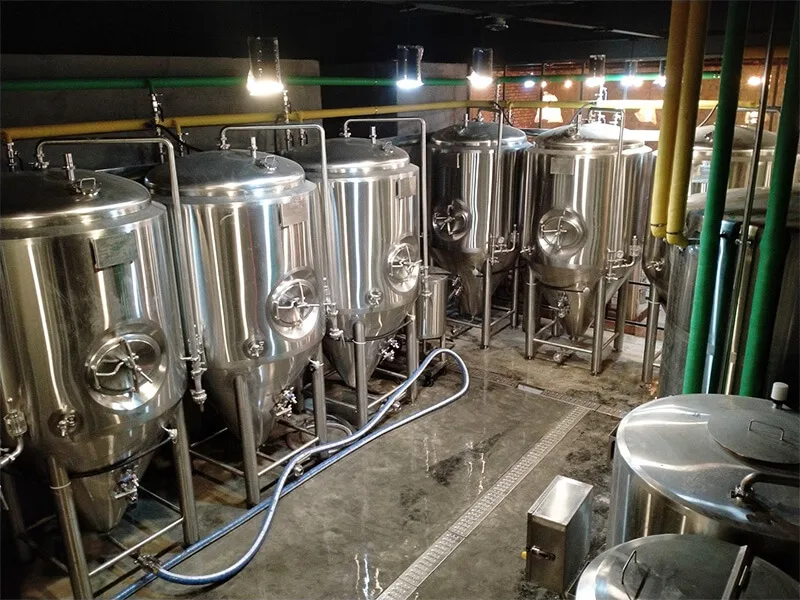
For most craft breweries and commercial beer producers, stainless steel conical fermenters offer significant advantages through:
- Better yeast management
- Improved sanitation
- More efficient production workflow
- 運用コストの削減
- Greater process control
As an experienced fermenter equipment manufacturer, METO works with breweries worldwide to design fermentation systems that match their production goals, technical requirements, and market standards.
Whether you are building a nano brewery, expanding a craft beer facility, or developing a complete turnkey brewery solution, selecting the right fermentation equipment is one of the most important decisions in building a reliable brewing operation.