Designing an industrial 2000L brewery production line is not simply a matter of scaling up brewing vessels.
At this production level, process stability, production efficiency, automation, and energy control become decisive factors that directly affect operating cost, beer consistency, and long-term scalability.
This article outlines the key engineering principles, system configuration, and a real-world 20BBL industrial brewhouse application that together demonstrate how to build a reliable and efficient 2000L industrial brewery.
1. Defining Production Capacity and Brewing Objectives
The first step in designing a 2000L industrial brewery is clarifying production goals:
- Target annual output (hL/year)
- Number of brews per day
- Core beer styles and fermentation cycles
- Packaging format and distribution strategy
A well-designed 2000L brewhouse typically supports 2–4 brews per day, with annual production ranging from 8,000 to 15,000 hL, depending on fermentation planning and operational efficiency.
Proper capacity definition ensures that all downstream systems—fermentation, cooling, and packaging—remain balanced and bottleneck-free.
2. Industrial Brewhouse System Design (2000L / 20BBL)
Recommended Brewhouse Configuration
A proven industrial configuration includes:
- Mash Tun
- Lauter Tun
- Boil Kettle
- Whirlpool Tank
- Hot Liquor Tank
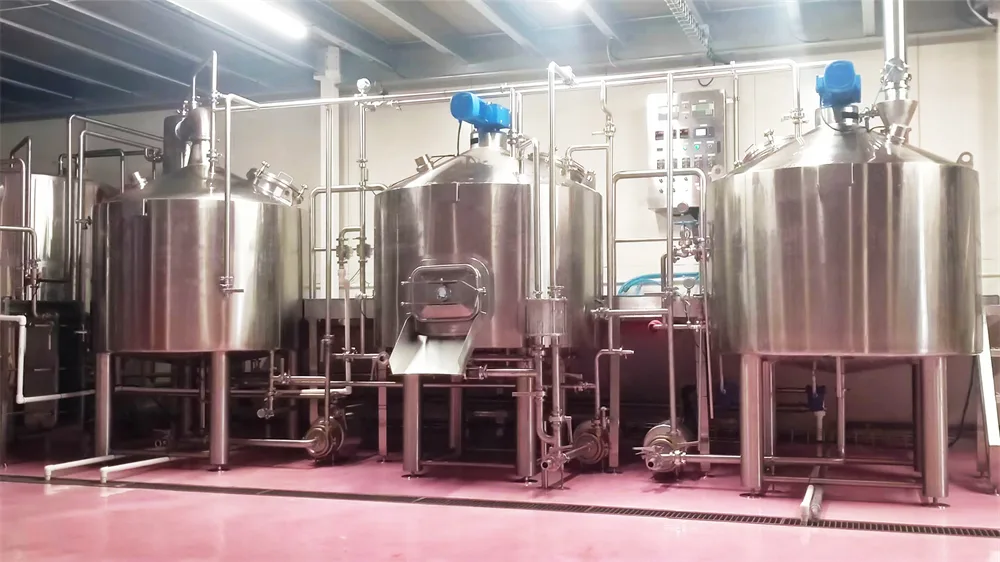
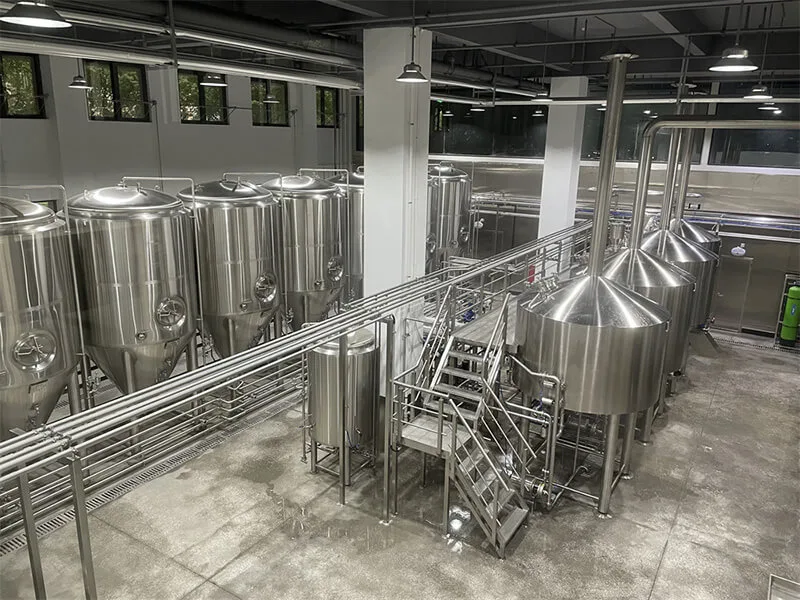
The three-vessel brewhouse design enables parallel operations, significantly improving brewhouse throughput while maintaining strict process control.
Steam-jacketed heating provides uniform thermal transfer, while high-efficiency lautering systems ensure stable extract performance and consistent wort quality across repeated batches.
3. Wort Cooling and Transfer System
At industrial scale, wort cooling must be fast, stable, and repeatable.
A typical system includes:
- SUS304 double-stage plate heat exchanger (20 m²)
- High-capacity sanitary wort pumps
- Inline hop filtration
- Accurate flow measurement and control
This configuration ensures precise pitching temperatures, minimizes oxygen pickup, and supports consistent fermentation performance.
4. Fermentation and Maturation Planning
Fermentation capacity ultimately defines brewery output.
A balanced 2000L industrial brewery typically includes:
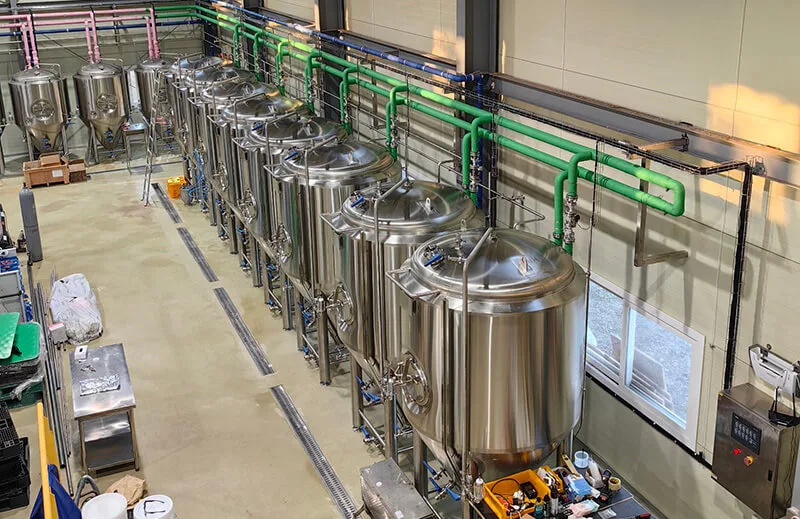
- 20BBL and 40BBL Fermentation Tanks / Unitanks
- Smaller 3BBL tanks for pilot brewing or specialty batches
All tanks are pressure-rated and jacketed for glycol cooling, supporting yeast management, natural carbonation, and cold conditioning.
As a general engineering rule, total fermentation volume should be 6–8 times the brewhouse size to maintain stable production scheduling.
5. Cooling, Utilities, and Energy Systems
Reliable temperature control is non-negotiable in industrial brewing.
Key supporting systems include:
- Central glycol chiller system
- Insulated glycol piping loop
- Steam heating system
- Condenser for vapor management
These systems ensure thermal stability while improving energy efficiency during continuous production.
6. Automation and Control Architecture
Automation plays a critical role in industrial brewery performance.
A PLC-based control system enables:
- Centralized process monitoring
- Automated pump and valve sequencing
- Recipe repeatability
- Reduced labor dependency
This architecture provides a scalable automation foundation, allowing future integration of additional tanks, packaging lines, or advanced data monitoring systems.
7. Example Application: 20BBL Industrial Three-Vessel Brewhouse
In an industrial brewery project application, a 20BBL three-vessel brewhouse system was selected to meet commercial production requirements with a strong focus on precision, efficiency, and consistency.
Brewhouse Engineering Features
The Mash/Lauter Tun is equipped with steam-jacketed heating, an ABB-driven raking system, and a precision-engineered false bottom, ensuring high extraction efficiency and excellent wort clarity.
The Boil Kettle delivers uniform heat transfer for vigorous boiling, optimal hop utilization, and effective hot break formation.
The Whirlpool Tank, designed with a tangential inlet, enables rapid trub sedimentation, producing bright, clean wort before fermentation.
Integrated Process Equipment
The system incorporates:
- ABB-driven sanitary pumps
- SUS304 double-stage plate heat exchanger
- Inline hop filter
- Automated valves
- IFM ultrasonic flowmeter
- Central PLC control system
This integrated design ensures repeatable brewing performance and compliance with modern industrial brewery standards.
Main Equipment Configuration
- Milling system: 1500–2000 kg/h with grain case / hopper
- Cervecería: 20BBL three-vessel system (MT/LT + BK + WT)
- Hot Liquor Tank: 60BBL, steam-heated
- Wort cooling: SUS304 double-stage plate heat exchanger (20 m²)
- Condenser system
- Inline hop filtration system
- Fermentation & Unitanks: 20BBL, 40BBL, and 3BBL
- Control system: Automatización basada en PLC
8. Why This Configuration Works at Industrial Scale
This 20BBL industrial brewery configuration is engineered to balance production efficiency, process stability, and long-term scalability—the core requirements of industrial brewing operations.
The three-vessel brewhouse design enables parallel processing while maintaining precise control over each production stage. Steam-jacketed heating and high-efficiency lautering deliver consistent extract performance and stable wort quality batch after batch.
From a systems engineering perspective, the integration of ABB-driven pumps, automated valves, and ultrasonic flow measurement ensures accurate volume control and repeatable wort transfer, minimizing human error and batch variation. The double-stage plate heat exchanger further enhances thermal efficiency and fermentation consistency.
The PLC-based automation architecture provides centralized monitoring and scalable control, allowing the brewery to expand fermentation capacity or integrate downstream packaging systems without re-engineering the core brewhouse.
Overall, this configuration offers a standardized, reliable foundation for breweries seeking industrial-level consistency, operational efficiency, and controlled growth.
Conclusión
Designing an industrial 2000L brewery production line requires a holistic engineering approach that integrates brewhouse design, fermentation planning, automation, and energy management.
With the right system architecture and equipment configuration, a 2000L industrial brewery can achieve high throughput, predictable operating costs, and long-term scalability, making it a strong foundation for commercial beer production.
📩 Póngase en contacto con us to receive a customized industrial brewery solution tailored to your production targets and facility conditions.