Choosing the right brewery size is one of the most important decisions when starting or expanding a craft brewery. For many commercial brewers, a 1000L Beer brewing equipment represents the ideal balance between production capacity, investment cost, and operational flexibility.
This guide walks you through everything you need to know about planning, building, and optimizing a modern brewery built around a 1000L brewhouse, from early-stage planning to long-term optimization.
Who Is a 1000L Brewery Solution Designed For?
A 1000L brewery setup is suitable for several common business models:
Nuevas cervecerías artesanales comerciales
For first-time brewery owners, a 1000L system offers:
- Manageable startup investment
- Commercial-scale production capacity
- Room for future expansion without overcommitting capital
Growing Breweries Scaling Up
Breweries upgrading from 500L or smaller systems often choose 1000L to:
- Increase output without increasing labor proportionally
- Improve consistency and process control
- Add more fermentation capacity for flagship beers
Brewpubs and Taproom-Based Breweries
For brewpubs, a 1000L system can:
- Support on-site consumption and limited distribution
- Maintain fresh beer supply
- Balance production efficiency with space constraints
Core Components of a Modern 1000L Brewing Equipment
A complete brewery is more than just a brewhouse. It is a fully integrated production ecosystem.
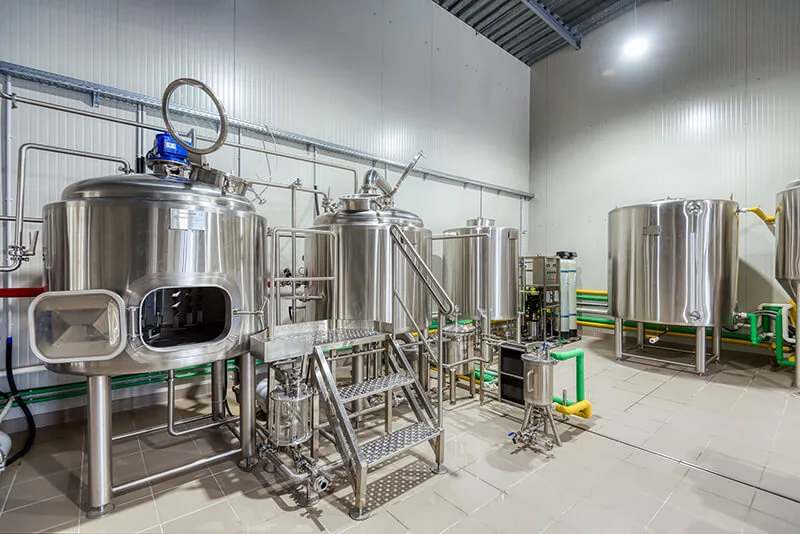
1. Brewhouse (Hot Block System)
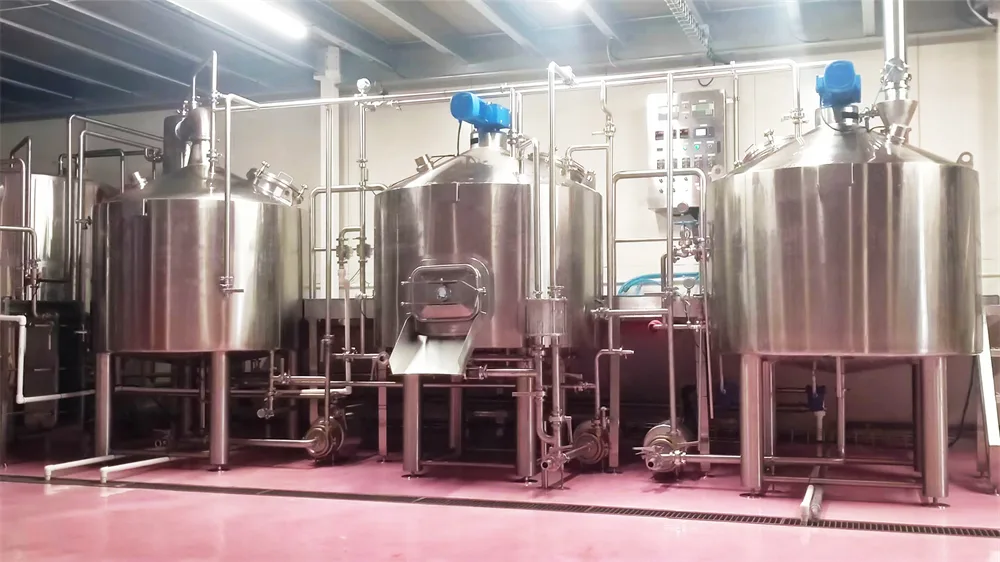
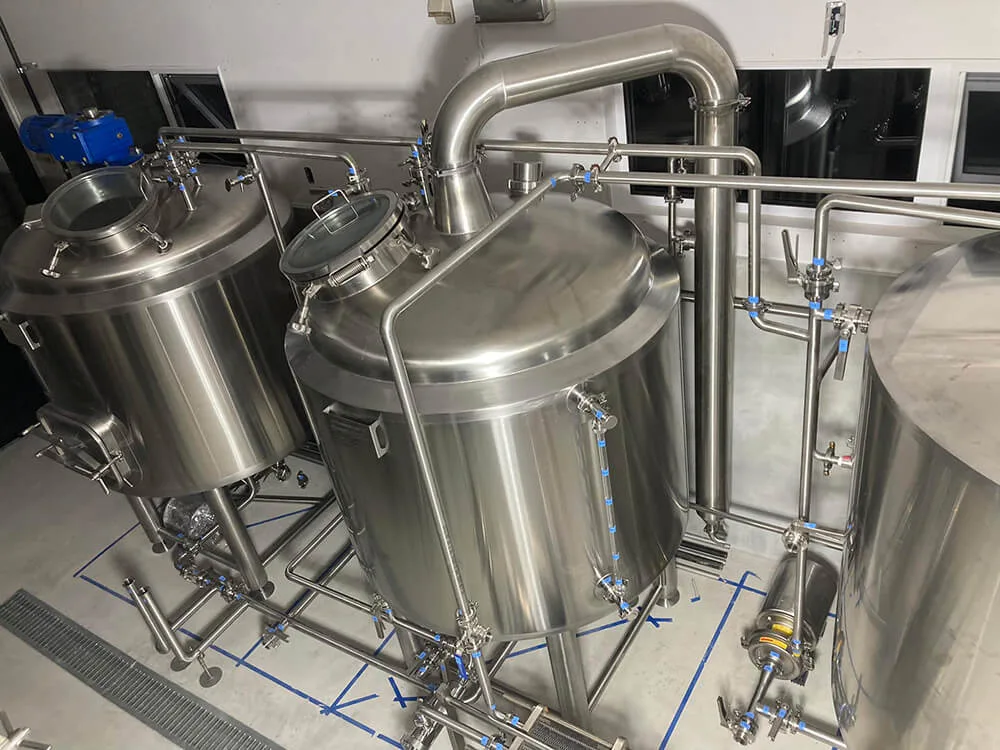
The brewhouse is the heart of beer production. A standard 1000L brewhouse typically includes:
- Mash Tun
- Lauter Tun
- Boil Kettle
- Whirlpool (or combined kettle/whirlpool)
For this scale, 3-vessel or 4-vessel configurations are commonly recommended to improve brewhouse efficiency, shorten brew days, and support multiple batches per day.
Key design considerations:
- Uniform heating and temperature control
- High wort clarity and extraction efficiency
- Energy-efficient heating (steam or electric)
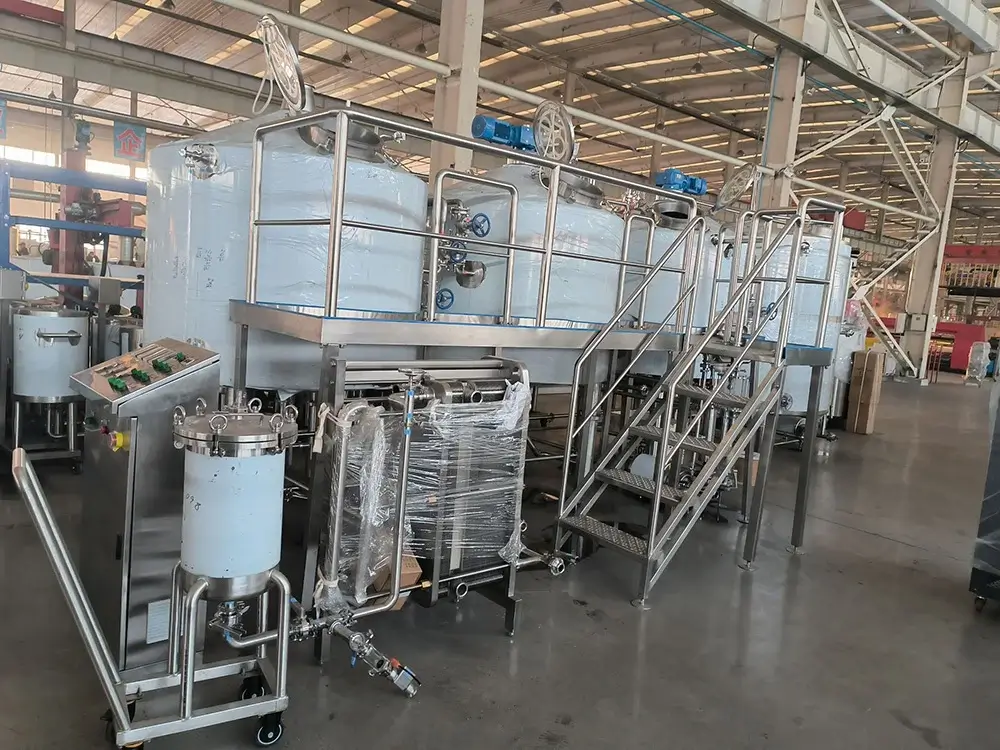
2. Fermentation & Cellar System (Cold Block)
After wort production, beer quality is shaped during fermentation and conditioning.
A typical 1000L cellar includes:
- Conical fermentation tanks (usually 4–8 units)
- Optional unitanks for fermentation and conditioning
- Glycol cooling system with precise temperature control
Proper fermentation capacity is essential. As a rule of thumb, cellar volume should be 4–6 times the brewhouse size to avoid production bottlenecks.
3. Packaging and Beer Transfer Systems
Finished beer must be packaged efficiently and hygienically.
Packaging options at the 1000L scale include:
- Kegging systems
- Manual or semi-automatic bottling lines
- Small-scale canning lines
The packaging system should match your sales model—taproom-focused breweries may rely primarily on kegs, while distribution-focused breweries often invest in cans or bottles.
4. Utilities and Auxiliary Systems
Behind every successful brewery is reliable infrastructure.
Essential utility systems include:
- Hot water tank and heat recovery
- CIP (Clean-In-Place) system
- Air compressor and CO₂ system
- Water treatment and wastewater management
Well-designed utilities reduce downtime, improve safety, and lower long-term operating costs.
5. Automation and Control Systems
Modern breweries increasingly rely on automation to maintain consistency and efficiency.
Common automation features include:
- PLC-based brewhouse control
- Automated temperature and pump control
- Recipe management and batch tracking
Even partial automation can significantly reduce human error and improve repeatability across batches.
6. Quality Control and Laboratory Setup
Consistent beer quality builds brand trust.
A basic brewery lab may include:
- Gravity and pH measurement tools
- Fermentation monitoring equipment
- Microbiological testing (basic level)
Quality control becomes especially important as production volume and distribution grow.
From Concept to Commissioning: A Practical Implementation Roadmap
Building a 1000L brewery typically follows these steps:
- Define Production Goals
Determine target beer styles, annual output, and sales channels. - Site Evaluation & Layout Planning
Assess space, ceiling height, drainage, power supply, and workflow. - System Design & Engineering
Finalize brewhouse configuration, cellar sizing, and utility requirements. - Equipment Manufacturing & Factory Testing
All equipment is fabricated and tested before shipment. - Installation & Commissioning
On-site installation, piping, electrical connections, and system testing. - Operator Training
Brewers and technicians receive hands-on training for daily operation and maintenance. - Trial Brewing & Optimization
Initial batches are used to fine-tune recipes and process parameters. - Ongoing Optimization & Expansion
Data-driven adjustments improve efficiency and prepare for future growth.
Frequently Asked Questions About 1000L Beer Brewing Equipment
How much beer can a 1000L brewery produce per year?
Production depends on brew frequency and fermentation capacity, but many 1000L breweries produce between 500,000–1,000,000 liters annually.
Is automation necessary at this scale?
Automation is not mandatory, but it greatly improves consistency, efficiency, and ease of operation.
Can the system be expanded later?
Yes. A well-planned 1000L brewery allows easy expansion by adding fermentation tanks, packaging upgrades, or automation modules.
Conclusión
A 1000L brewing equipment is a proven and flexible solution for commercial craft breweries seeking sustainable growth. With proper planning, smart equipment configuration, and scalable design, it provides an excellent foundation for long-term success.
If you are planning to build or upgrade a brewery, a professionally engineered 1000L brewery solution can help you maximize efficiency, control quality, and grow with confidence.Póngase en contacto con nosotros to start your brewery project.