Introduction: From Craft to Industrial Brewing
As the craft beer industry evolves toward scalability, branding, and standardization, many investors, brewers, and equipment buyers face the same questions:
- Why do small systems use 2- or 3-vessel brewhouses, while 2500L+ breweries almost always adopt 4-vessel systems?
- What truly determines whether a brewery can scale, stay profitable, and deliver consistent quality?
The answer lies not only in the brewhouse configuration—but in three critical infrastructure systems:
- CIPシステム
- Precision Cooling System
- Automation & Control System
Using a real-world 2500L industrial brewery project, this article breaks down both engineering logic and operational realities.
1. Why Large Breweries Require a 4-Vessel Brewhouse
1.1 Parallel Processing Enables High Throughput
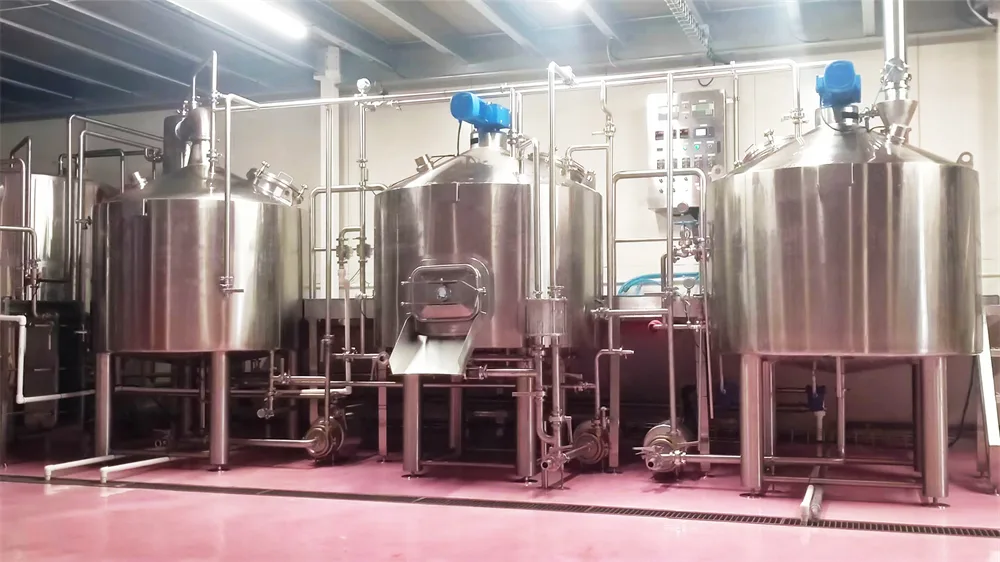
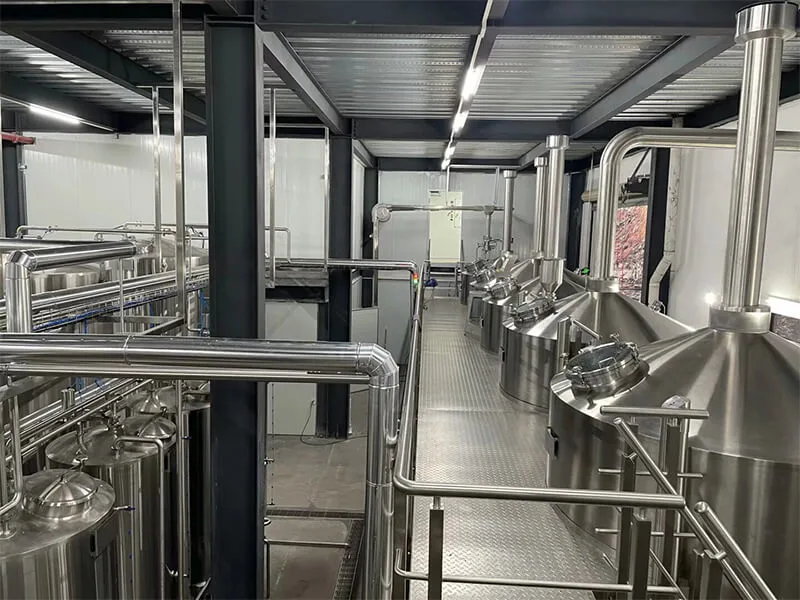
A 4-vessel brewhouse separates each stage into dedicated vessels:
- Mash Tun – starch conversion
- Lauter Tun – wort separation
- Kettle – boiling & hop addition
- Whirlpool – trub separation
Unlike 2- or 3-vessel systems (where tanks are reused sequentially), a 4-vessel setup allows simultaneous operations.
Result:
- Continuous brewing workflow
- No waiting between steps
- Stable production of 4–5 batches per day (2500L each)
👉 This level of throughput is nearly impossible with smaller configurations.
1.2 Higher Extract Efficiency & Product Stability
Large-scale breweries prioritize consistency over experimentation.
A 4-vessel system improves:
- Wort yield (dedicated lautering)
- Clarity (independent whirlpool separation)
- Process control (temperature, pH, timing)
Outcome:
- Cleaner beer profile
- Stable batch-to-batch flavor
- Reduced variability
👉 Transition from “experience-based brewing” → “process-driven brewing”
1.3 Automation & Pneumatic Systems Boost Efficiency
Modern 2500L brewhouses integrate:
- Pneumatic spent grain discharge
- Automated valves & pumps
- Programmable brewing steps
メリット
- Reduced manual labor
- Faster turnaround time
- Lower contamination risk
👉 Industrial brewing requires repeatability, not manual dependency
1.4 Built for Future Expansion
A key advantage of 4-vessel systems is modular scalability.
Once the brewhouse is installed:
- Expansion only requires adding more fermenters
- No need to replace core production equipment
Production scalability:
- Phase 1: ~1200 tons/year
- Phase 2: up to ~3000 tons/year
👉 Lower long-term investment risk with flexible growth
2. The 3 Critical Systems That Define Brewery Survival
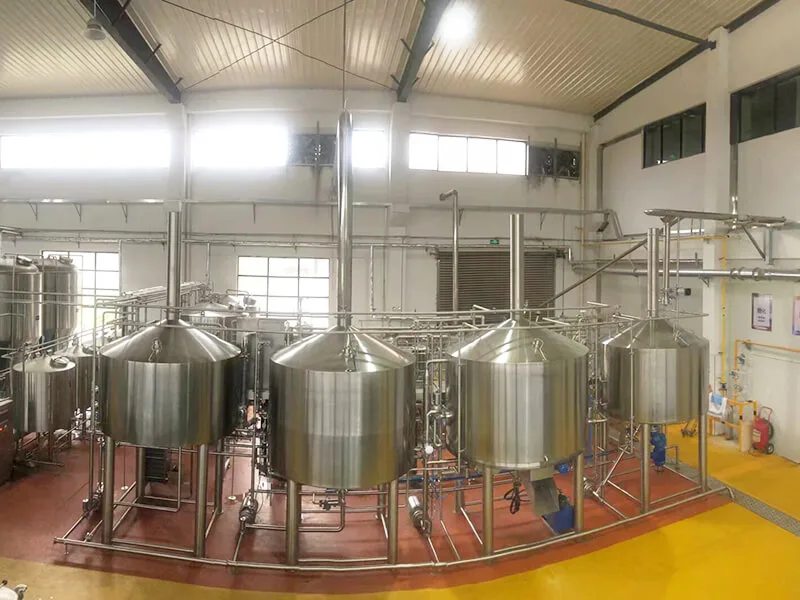
A brewhouse produces wort—but these three systems determine whether your brewery can survive and scale.
2.1 CIP System – The Foundation of Sanitary Brewing
Manual cleaning is not viable at scale.
A standard industrial CIP system includes:
- Alkali tank (1T)
- Acid tank (1T)
- Sanitizing tank (1T)
- Hot water tank (1T)
- Pumps, pipelines, and automation
Core advantages:
- Fully automated cleaning cycles
- High-temperature chemical circulation
- No dead zones, no manual entry
Business impact:
- Prevent contamination & batch loss
- Meet food safety and export standards
- Reduce downtime between batches
👉 Without CIP, industrial brewing is not sustainable
2.2 Precision Cooling System – The Guardian of Beer Flavor
Fermentation is highly temperature-sensitive:
- ±1°C affects flavor
- ±3°C can ruin the entire batch
A 2500L brewery typically includes:
- Glycol tank (~8 tons)
- Industrial chiller (~20HP)
- Closed-loop piping system
- Temperature control modules
Covers entire process:
- Wort cooling
- Fermentation control
- Cold storage
Impact:
- Stable yeast performance
- Aroma preservation
- Consistent product quality
👉 Cooling is not an option—it is critical infrastructure
2.3 Automation System – The Brain of the Brewery
Manual brewing cannot support:
- Multi-batch daily production
- Continuous operation
- Data tracking & consistency
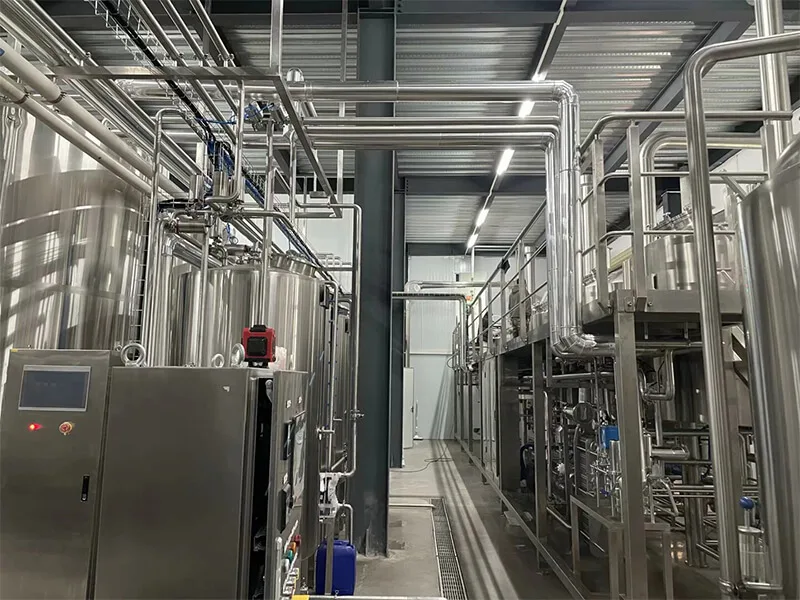
Standard automation setup:
- PLC controller (e.g., Siemens)
- HMI touch screen (MCGS)
- Sensors: temperature, pressure, flow, level
- Remote monitoring (WiFi / IoT)
- Data logging & alarm systems
Capabilities:
- Fully automated brewing process
- High precision parameter control
- Remote access & monitoring
- Traceable production data
Result:
- Reduced labor dependency
- Higher consistency
- Scalable production management
👉 Automation transforms brewing into a data-driven industrial process
3. Real Operational Benefits of a 2500L Brewery Setup
Production Capacity
- 2500L per batch
- 4–5 batches/day
- 1200–3000 tons/year
Quality Consistency
- Standardized process control
- Minimal batch variation
Operational Efficiency
- Automated cleaning & control
- Reduced labor cost
- Faster production cycles
Scalable Investment
- Modular expansion via fermenters
- Lower long-term capital risk
Market Readiness
- Meets compliance standards
- Suitable for:
- Bars & restaurants
- Retail & supermarkets
- Distribution & export
4. Conclusion: The Industrial Standard for Modern Breweries
Why 4-vessel brewhouse?
Because it delivers efficiency, scalability, and consistency required for industrial brewing.
Why CIP, cooling, and automation?
- CIP = Safety → contamination-free production
- Cooling = Flavor → stable fermentation & aroma
- Automation = Efficiency → scalable, repeatable processes
Final Insight
For breweries aiming at long-term growth, regional distribution, and brand consistency:
👉 A 4-vessel brewhouse + CIP + cooling + automation is not a premium upgrade—it is the minimum viable industrial standard.
While some are still debating cost savings on equipment, successful breweries are already leveraging this configuration to maximize output, ensure quality, and secure market share.
👉 お問い合わせ for a custom brewhouse system design tailored to your production goals, budget, and future expansion plans.